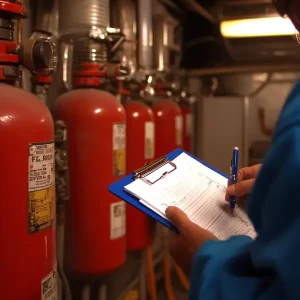
Fire Doors for Flats London: 2026 Regulations, HMO Rules & Inspection Guide
Regulatory Compliance Notice: This statutory guidance reflects mandatory obligations under the Fire Safety Act 2021, the Fire Safety (England) Regulations 2022 (Regulation 10), and the Housing Act 2004. Reviewed by IFE-accredited assessors for London landlords, managing agents, and resident management companies (RMCs).
London Landlord & Block Manager Snapshot: Fire Doors for Flats in London (2026)
- Communal Fire Doors: Mandatory quarterly checks (every 3 months) for all fire doors in common areas of residential blocks over 11 metres.
- Flat Entrance Doors: Mandatory annual checks on all flat entrance fire doors leading onto communal corridors in buildings over 11m (on a “best endeavours” basis).
- FD30S Standard: Doors must provide 30 minutes of fire resistance AND cold smoke containment (fitted with intumescent strips and cold smoke brush/blade seals).
- Certified Self-Closers: Overhead hydraulic or concealed closers must reliably close the door firmly onto the rebate and engage the latch from any angle.
- Enforcement Risk: London Fire Brigade and borough licensing authorities issue binding Article 30 Enforcement Notices and uncapped magistrates’ fines for uncertified doors.
Fire doors are the frontline defense against smoke inhalation and toxic gas spread in high-density residential properties. In multi-occupied blocks of flats, conversions, and Houses in Multiple Occupation (HMOs) across London, a fire door is not merely a piece of joinery—it is an engineered life-safety barrier designed to hold back blistering flames and suffocating smoke for a minimum of 30 minutes, keeping escape stairwells passable.
Following the formal implementation of the Fire Safety (England) Regulations 2022 and the heightened audit powers granted to the London Fire Brigade (LFB) under the Fire Safety Act 2021, building managers and landlords face stringent legal oversight. Failure to prove documented, routine fire door checks can void building insurance policies, trigger enforcement action, and halt rental property licensing applications.
The Legal Framework: Fire Safety Act 2021 & Regulation 10
Prior to recent regulatory overhauls, flat front doors often fell into a legal gray area between private leasehold demises and common parts. The Fire Safety Act 2021 permanently resolved this ambiguity by confirming that in all multi-occupied residential buildings, the scope of the Regulatory Reform (Fire Safety) Order 2005 (RRFSO) extends directly to:
- The building’s structure and external walls (including cladding, balconies, and windows).
- All flat entrance doors leading onto communal corridors and escape routes.
- All communal doors situated within shared hallways, staircases, risers, and plant rooms.
For building owners, freeholders, and appointed managing agents—designated in law as the “Responsible Person”—the Fire Safety (England) Regulations 2022 (Regulation 10) created two strict statutory inspection tiers depending on building height:
| Building Category / Height | Communal Doors Schedule | Flat Entrance Schedule | Required Rating | Responsible Party |
|---|---|---|---|---|
| Residential Blocks > 11m (approx. 4+ storeys) | Quarterly (Every 3 months) routine checks | Annual (Every 12 months) via best endeavours | FD30S (BS 476 / EN 1634) | Freeholder / Managing Agent |
| Residential Blocks < 11m (conversions, low-rise) | Assessed in regular Fire Risk Assessment (min annual) | Sampled/checked during routine FRA updates | FD30 / FD30S certified | Responsible Person / RMC |
| HMO Properties (Shared Houses & Bedsits) | Quarterly inspection of all shared circulation paths | Every tenancy change & min 6-monthly check | FD30S on all bedroom & risk doors | HMO Licence Holder / Landlord |
| Individual Leasehold Flat (Private Let) | Maintained by building freeholder via service charge | Tenant must grant access; landlord ensures closer works | FD30S fire door set | Leaseholder & Tenant cooperation |
To learn more about overarching building compliance protocols, review our detailed guide on Fire Risk Assessment London rules and landlord obligations.
FD30 vs FD30S: Technical Standards & Fire Door Anatomy
A standard interior wooden door burns through in roughly 5 to 10 minutes. A certified fire door is an engineered assembly manufactured under stringent laboratory conditions to withstand flame, heat, and smoke. The two primary classifications used in UK residential housing are FD30 and FD30S:
- FD30: Tested to BS 476 Part 22 or BS EN 1634-1, guaranteeing 30 minutes of fire integrity (preventing the passage of flames and hot gases).
- FD30S: In addition to 30 minutes of fire resistance, it features the crucial “S” suffix, denoting certified cold smoke leakage performance tested to BS 476 Section 31.1.
In blocks of flats and HMOs, cold smoke is the silent killer—responsible for over 60% of fire-related deaths due to disorientation and carbon monoxide poisoning in common staircases. All flat entrance doors and communal corridor doors must be FD30S, fitted with combination intumescent fire and smoke brush or blade seals.
The 5 Crucial Components of a Certified Fire Door Assembly:
- Solid Core Door Leaf (Min 44mm): Constructed with a solid timber or high-density composite mineral core. Must bear an identifiable third-party certification plug (e.g., BM TRADA Q-Mark or Certifire label) on the top edge.
- Intumescent Strips & Smoke Seals: Recessed into the head and stiles of the door frame or leaf. At temperatures exceeding 200°C, intumescent material swells up to 10 times its original volume, sealing the perimeter gap. The integrated nylon brush or elastomeric blade prevents deadly cold smoke infiltration prior to heat activation.
- Certified Self-Closing Device (BS EN 1154): Flat entrance and communal doors must feature a reliable mechanical self-closer (minimum Power Size 3). It must be capable of closing the door fully into the rebate and latching shut from any opening angle, overcoming latch resistance and air pressure.
- Fire-Rated Ball-Bearing Hinges (BS EN 1935): A minimum of three Grade 13 CE/UKCA marked hinges must be installed, lined with non-combustible intumescent pads behind the hinge flaps to prevent heat transfer through the screw fixings.
- Fire-Resistant Latch & Hardware (BS EN 12209): Steel latch with at least a 12mm throw. For HMO bedrooms, latches must incorporate a thumb-turn cylinder (BS 8621) allowing escape without a key.
Book Certified Fire Safety & Door Surveys in London


Fire Risk Assessments For Communal Areas

Fire Risk Assessments For All Business Sectors

Emergency Lights Installation
2026 London Fire Door Inspection & Remediation Costs
Maintaining fire door compliance across London rental properties involves periodic visual surveys, detailed certified audits, and necessary joinery remediation. Here is an itemized breakdown of typical 2026 London pricing:
| Service / Remediation Task | Average London Price (2026) | Inspection Turnaround | Statutory Standard Met |
|---|---|---|---|
| Communal & Flat Door Audit (Up to 10 doors) | £175 – £250 | 24-Hour Digital PDF | Reg 10 Fire Safety (England) |
| HMO Fire Risk & Door Audit (3 to 6 beds) | £149 – £195 | 24-Hour Digital PDF | LACoRS / Housing Act 2004 |
| Retrofit Hydraulic Self-Closer (Overhead) | £85 – £145 per door | Same-day installation | BS EN 1154 Power Size 3 |
| Intumescent Strip & Smoke Seal Replacement | £45 – £75 per door | Same-day remediation | BS 476 Part 22 / BS 8214 |
| Thumb-turn Security Lock Upgrade (BS 8621) | £95 – £160 per door | Immediate fitting | Keyless Egress Mandate |
| Full FD30S Pre-Hung Fire Door Set Replacement | £480 – £850 per set | 1–2 Days Installation | Certifire / BM TRADA Q-Mark |
For combined landlords certificates and safety packages, see our transparent pricing across London Landlord Safety Certificates including Gas Safety CP12, EICR, and EPC certificates.
HMO Fire Door Rules: Licensing & Bedroom Compartmentalisation
Houses in Multiple Occupation represent the highest statistical risk for domestic fire fatalities in the UK due to multiple independent households sharing cooking and escape routes. Under the Housing Health and Safety Rating System (HHSRS) and local council licensing standards (Mandatory, Additional, and Selective licensing), fire door standards are rigorously enforced across London boroughs.
Mandatory HMO Door Requirements Under LACoRS Guidance:
- All Letting Bedrooms: Every individual tenant bedroom door must be a certified FD30S fire door with self-closer, 3 hinges, intumescent strips, and cold smoke seals.
- Communal Kitchens & Living Areas: High-risk rooms (especially kitchens with gas cookers or heavy appliance loads) require heavy-duty FD30S doors to isolate potential cooking fires from the primary escape corridor.
- Keyless Egress (Thumb-Turn Locks): In an HMO, locks that require a physical key to exit from the inside are strictly illegal. If a hallway fills with thick toxic smoke at 3:00 AM, tenants must be able to escape instantly by twisting an internal thumb-turn mechanism (BS 8621 standard).
- Under-Stair Storage & Boiler Cupboards: Any under-stair storage area or gas boiler cupboard situated along the means of escape must be enclosed in 30-minute fire-resisting construction with a lockable FD30 fire door kept locked shut.
Ensure your electrical installation and gas systems are also protected by scheduling your statutory EICR Certificate London and annual Gas Safety Certificate London concurrently with your fire door checks. For properties let on short-term platforms or serviced lets, see our guide on Airbnb Fire Risk Assessment London.
7-Point London Landlord Fire Door Inspection Checklist
Whether conducting your mandatory quarterly communal checks or preparing for a local authority licensing visit, follow this certified 7-point visual inspection protocol:
- Check Third-Party Certification: Look at the top or side edge of the door leaf. Verify the presence of an unbroken colour-coded plug or Certifire/BM TRADA label confirming fire test history.
- The 3–4mm Gap Rule: Inspect the perimeter gap between the door leaf and frame at the top and both sides. The gap should consistently measure between 3mm and 4mm (about the thickness of a £1 coin). Gaps over 4mm allow smoke and heat penetration before intumescent activation.
- Threshold Under-Door Clearance: Measure the gap beneath the bottom of the door and the finished floor. For fire integrity, it should not exceed 8mm; if cold smoke containment (FD30S) is required, the gap must not exceed 3mm or be fitted with an approved drop-down smoke seal.
- Intumescent & Smoke Seal Condition: Inspect seals along the frame or door edge. Ensure they are continuous, well-adhered, undamaged, and crucially have never been painted over. Heavy gloss paint ruins seal expansion and damages smoke brushes.
- Self-Closing Mechanism Test: Open the door to 75 degrees and let it go—it should shut smoothly and latch completely into the keep without manual assistance. Then test from 15 degrees: the door must overcome the latch bolt resistance firmly.
- Hinges & Hardware Integrity: Verify that 3 Grade 13 hinges are securely screwed with no missing fixings, no metal shavings, and no hydraulic oil leaking from overhead closer arms.
- Mandatory Statutory Signage: Ensure communal fire doors display circular blue “Fire Door Keep Shut” signs at eye level on both faces. Plant and electrical cupboards must display “Fire Door Keep Locked”.
Document every check in your building’s Fire Safety Logbook. If any door fails to latch or displays damaged intumescent strips, commission certified repairs immediately to maintain statutory compliance.
Complete London Landlord Compliance
Fire doors are a statutory requirement under building safety legislation. For complete private rented sector compliance—including annual gas CP12, 5-year EICR, and EPC checks—book certified Property Safety Checks London (or read our London Landlord Compliance Checklist).
Frequently Asked Questions: Fire Doors for Flats London
Who is legally responsible for fire doors in leasehold flats?
Under the Fire Safety Act 2021 and Fire Safety (England) Regulations 2022, the building’s designated Responsible Person (the freeholder, building owner, or appointed managing agent) is legally responsible for inspecting and maintaining all communal fire doors and facilitating annual checks on flat entrance fire doors leading onto shared corridors. While leaseholders generally own the physical door under their lease agreement, they have a legal duty to permit access and ensure the door complies with the building’s fire strategy.
How often must fire doors be inspected in residential blocks in London?
In residential buildings over 11 metres (approximately 4 storeys or higher), the Responsible Person must inspect all fire doors in communal areas quarterly (every 3 months). Flat entrance doors must be inspected annually (every 12 months) on a ‘best endeavours’ basis. In buildings under 11 metres, inspection frequencies are determined by your periodic Fire Risk Assessment (typically reviewed annually or every 2 years).
Can a tenant or leaseholder replace their front door without freeholder permission?
No. Flat entrance doors opening onto interior communal escape corridors form a vital part of the building’s statutory compartmentalisation. Any replacement door must be a certified FD30S fire door set (with certified frame, intumescent strips, cold smoke seals, and compliant self-closer). Leaseholders must provide certification documentation and obtain freeholder approval prior to fitting.
What is the key difference between FD30 and FD30S fire doors?
Both doors provide a minimum of 30 minutes of fire resistance against flames and heat. However, FD30S doors include the ‘S’ rating for cold smoke leakage protection (tested to BS 476 Section 31.1), achieved using integrated flexible brush or blade smoke seals. Because smoke inhalation is the primary cause of casualty in flat corridors, FD30S is the mandatory standard for flat entrance and escape route doors.
Do bedroom doors in an HMO need to be self-closing fire doors?
Yes. Under the Housing Act 2004 and LACoRS fire safety standards, every letting bedroom in a licensable HMO must be fitted with an FD30S fire door and an overhead hydraulic self-closer. This prevents a fire originating in one tenant’s bedroom (e.g. from portable heaters or lithium batteries) from spreading into the shared escape corridor.
What lock type is legally required on HMO fire doors?
All bedroom and exit doors along an escape route in an HMO must be fitted with keyless egress locks (BS 8621), typically featuring an internal thumb-turn mechanism. Tenants must never require a physical key to exit their room or the building in the event of dense smoke or emergency power loss.
Can you paint over intumescent strips and smoke seals on a fire door?
No. Painting over intumescent strips or smoke brush seals is one of the most common causes of inspection failure. Thick layers of gloss paint can delay intumescent expansion during a fire and mat the nylon smoke brushes, allowing toxic smoke to infiltrate corridors unchecked.
What happens if a landlord or block fails a London fire door inspection?
If the London Fire Brigade identifies defective fire doors during an audit, they can issue an informal notice of deficiency, a formal Article 30 Enforcement Notice, or in severe cases an Article 31 Prohibition Notice closing the premises. Local councils can also issue financial civil penalties of up to £30,000 per breach under the Housing Act 2004 or pursue unlimited criminal fines in magistrates’ court.
Book Certified Fire Safety & Door Inspections Across London
Ensure 100% compliance with London Fire Brigade and Council Licensing standards. Certified IFE and NEBOSH assessors, comprehensive 24h digital reports, and guaranteed pass rates across all 32 London boroughs from £119.
Related Blogs
Fire Doors for Flats London: 2026 Regulations, HMO Rules & Inspection Guide
Fire doors are the frontline defense against smoke inhalation and…
London Landlord Compliance Checklist 2026: Safety Certificates & Legal Rules
Editorial Note: Written by the Smart Property Checks Compliance Team…
PRS Database London 2026–2027: Landlord Registration, Deadlines & Compliance Guide
Editorial Note: Written by the Smart Property Checks Technical Compliance…