Commercial Lease Compliance: Is Landlord or Tenant Responsible?
In UK commercial property management, determining statutory maintenance liability between landlords and business tenants is often complex. Understanding commercial lease compliance responsibility under Full Repairing and Insuring (FRI) leases ensures legal compliance with fire safety, electrical testing, and MEES energy standards. You can book an accredited Commercial Property Compliance Package online with qualified surveyors across the UK.
For official government guidance on commercial property regulations, review the GOV.UK Commercial Property Regulations.
Who is responsible for commercial lease compliance in the UK?
Responsibility depends on the specific lease structure (Full Repairing & Insuring vs Internal Repairing) and the statutory legislation governing each safety duty. Under UK law, statutory health and safety obligations cannot be entirely contracted away, meaning both parties often share legal exposure.
In standard Full Repairing and Insuring (FRI) leases, the commercial tenant assumes operational responsibility for internal electrical installations, fire alarms, and PAT testing, while the building owner remains responsible for the commercial EPC and communal structural safety.
Compliance breakdown: Landlord vs Commercial Tenant duties
Statutory responsibilities across core commercial compliance disciplines include:
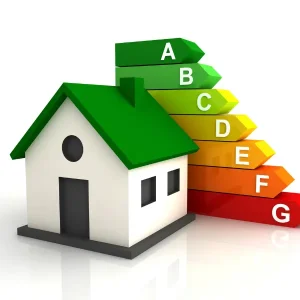
- Commercial EPC (MEES): Exclusively the landlord’s legal responsibility. Landlords cannot lawfully grant or maintain a commercial lease below Band E without registered exemptions.
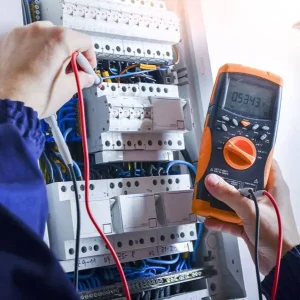
- Commercial EICR (5-Year Test): In a whole-building FRI lease, the tenant is responsible for maintaining electrical installations; in multi-tenanted offices, the landlord tests communal switchboards and tenants test their demised fit-outs.
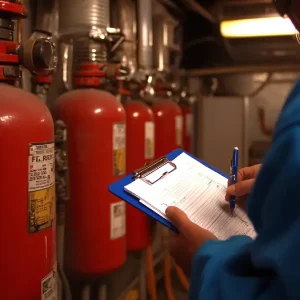
- Fire Risk Assessment (FRA): The employer/tenant is the “Responsible Person” within their demised trading area, while the landlord manages communal stairwells, risers, and main alarm panels.
- Asbestos Management (CAR 2012): The “Dutyholder” is defined by who has control over building maintenance—typically shared between tenant and landlord.
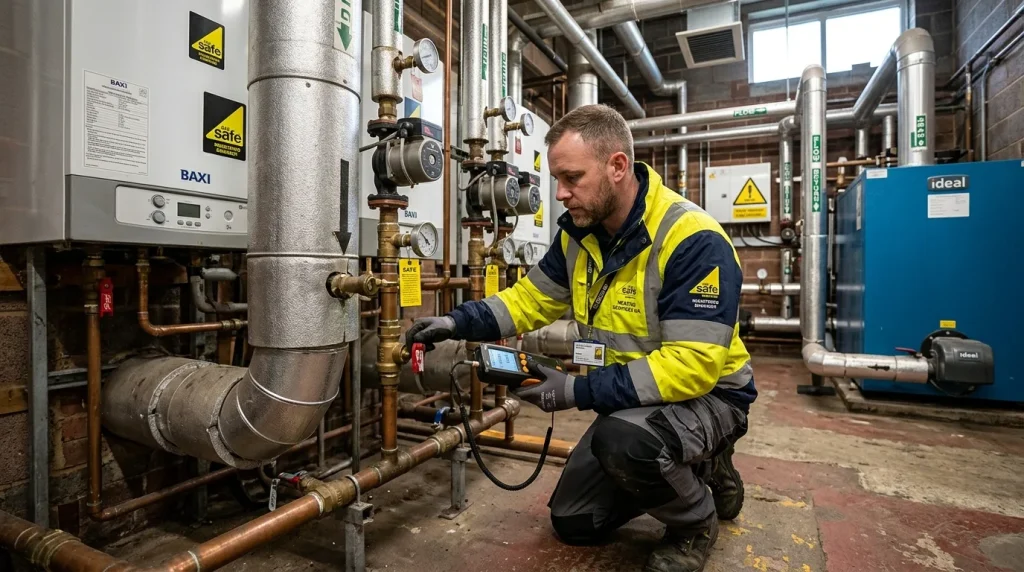
- Commercial Gas Safety: The party that owns and controls the boiler or commercial catering installation must arrange annual CP15/CP17 checks.
- Product Promotion: Book your Commercial EICR, Non-Domestic EPC, and Fire Risk Assessment with Smart Property Checks for complete commercial peace of mind.
- Dilapidations Claims: Landlords routinely serve dilapidations claims on outgoing tenants who fail to provide valid 5-Year EICR and electrical maintenance certificates.
- Commercial MEES Fines: Local authorities can fine landlords up to £150,000 for letting commercial properties with sub-standard EPC ratings (Bands F & G).
- Multi-Tenanted Blocks: Freeholders must coordinate building-wide emergency lighting, dry risers, and central fire alarm integration.
Failure to maintain statutory commercial compliance can result in HSE prohibition notices halting business operations, council financial penalties of up to £150,000 under MEES, and complete refusal of fire and building insurance payouts.
How to avoid compliance disputes at lease renewal or exit
Ensure the commercial lease agreement clearly defines statutory inspection obligations in the service charge schedule. Commissioning an independent commercial compliance audit prior to lease signing establishes an undisputed baseline condition.
Book Your Property Safety Certificate Online


Domestic Electrical Safety Certificate EICR 1-3 Bedroom

Fire Risk Assessments For HMO's & Rental Homes

Domestic EPC Certificate 1-3 Beds
Key commercial building systems audited during compliance surveys
Three-Phase Switchgear (EICR)
Testing 400V three-phase commercial distribution boards, sub-panels, busbar chambers, and power factor correction units.
Commercial HVAC & Energy (EPC)
Assessing central plant boilers, VRF air conditioning heat pumps, ventilation heat recovery, and SBEM energy efficiency ratings.
Life Safety & Fire Alarms
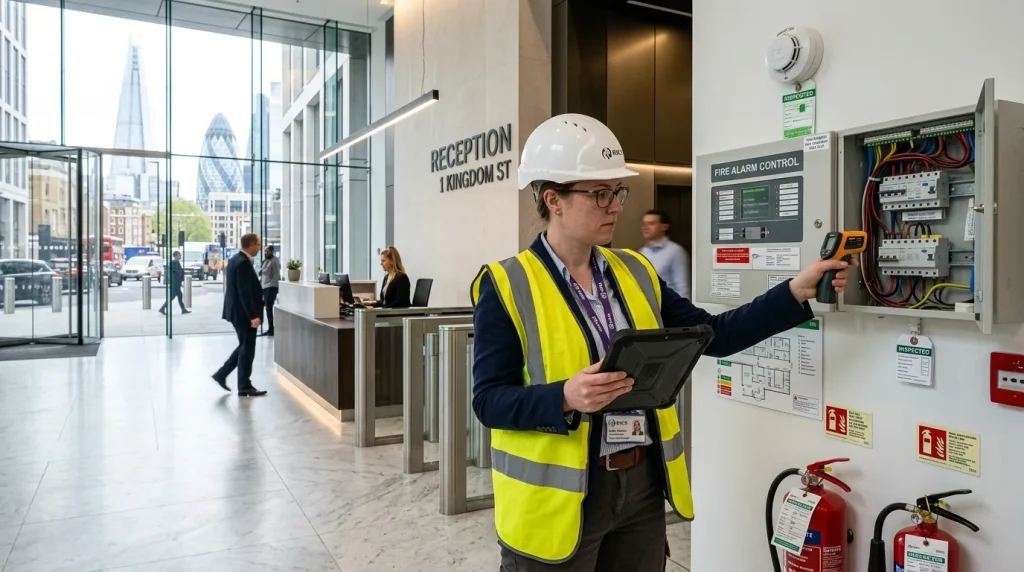
Inspecting BS 5839 L1/L2 fire alarm call points, smoke beam detectors, emergency battery luminaires, and sprinkler valves.
Non-Domestic Asbestos Register
Auditing Asbestos Insulating Board (AIB) ceiling tiles, pipe insulation, and vinyl floor tiles under CAR 2012 Regulation 4.
Why choose Smart Property Checks?
Smart Property Checks provides comprehensive commercial compliance packages for landlords, managing agents, and business tenants across the UK. We coordinate commercial Gas Safe, NICEIC electrical, and IFE fire assessors in single appointments. Contact our team to schedule your commercial audit.
The booking process
- Select your commercial compliance bundle based on floor area and building type
- We arrange seamless access with your building facilities manager
- Our certified commercial engineers complete all on-site electrical, energy, and fire audits
- Receive your complete suite of verified commercial certificates within 48 hours
Book your commercial compliance package today with Smart Property Checks and ensure complete business compliance.
Common Questions
Who pays for a commercial EPC: landlord or tenant?
The commercial landlord is legally responsible for obtaining and paying for a Commercial EPC before leasing or marketing the building.
Who is responsible for the EICR in a commercial lease?
Under a Full Repairing and Insuring (FRI) lease, the tenant is responsible for electrical testing within their demised unit; in shared buildings, the landlord tests communal supplies.
What is an FRI (Full Repairing and Insuring) lease?
An FRI lease transfers all maintenance, repair, compliance, and building insurance costs from the landlord directly to the tenant.
Can a commercial landlord be fined if a tenant fails to do fire checks?
Yes. In multi-occupied commercial properties, the freeholder retains joint responsibility under the Fire Safety Order for communal life safety systems.
How often is an EICR required in commercial properties?
Commercial properties typically require an EICR inspection every 3 to 5 years, depending on building usage, environment, and insurance terms.
What happens if a commercial building has an EPC rating of Band F?
It is unlawful to let or continue letting the property unless a valid statutory MEES exemption has been approved and registered on the PRS register.
Can Smart Property Checks assess both commercial and residential portfolios?
Yes. We provide nationwide compliance testing for mixed-use developments, commercial offices, retail units, and residential portfolios.
Book your commercial compliance package with Smart Property Checks
Protect your commercial leases and prevent massive regulatory penalties. Book your commercial electrical, energy, and fire audits with accredited engineers in minutes.
Related Blogs
Commercial Kitchen Gas Safety (CP42): 2026 UK Interlock & Legal Guide
Ensuring compliance with commercial kitchen gas safety regulations is a…
Commercial Lease Compliance: Is Landlord or Tenant Responsible?
Home In UK commercial property management and commercial lease compliance,…
Commercial Gas Safety Certificate: 2026 UK Business & Landlord Guide
Home Under the Gas Safety (Installation and Use) Regulations 1998…