Fire Risk Assessment for Communal Areas: 2026 UK Block Manager Guide

📋 Fire Regulations for Communal Areas in Flats (2026 UK Legal Overview)

Under the Regulatory Reform (Fire Safety) Order 2005 and the Fire Safety Act 2021, landlords, freeholders, and block managing agents are legally required to carry out a certified fire risk assessment for communal areas in flats. This statutory duty covers all shared common parts, including entrance lobbies, shared stairwells, corridors, electrical intake cupboards, external walls, and flat entrance fire doors.

  • Zero Tolerance on Hallway Clutter: Communal corridors and escape stairs must remain 100% sterile. Door mats, prams, bicycles, and shoe racks are strictly prohibited under communal hallway fire regulations to prevent toxic smoke spread and trip hazards.
  • FD30 Fire Doors: Flat front entrance doors opening onto common escape routes must be certified FD30 fire-resisting doors fitted with functional self-closing devices and intumescent smoke seals.
  • Emergency Escape Lighting: Mandatory backup illumination along escape routes operating for at least 3 hours during power failure (BS 5266-1).
  • Downloadable Fire Safety Checklist: Free communal inspection checklist included below to help block managers ensure 100% compliance.

Book Communal Area Fire Risk Assessment from £119 →

Under the Regulatory Reform (Fire Safety) Order 2005 and Fire Safety (England) Regulations 2022, property managing agents, freeholders, and landlords have a statutory duty to carry out a comprehensive fire risk assessment communal areas for blocks of flats and HMOs. You can book an accredited Fire Risk Assessment for Communal Areas or Business Fire Risk Assessment online with certified IFE registered assessors.

For official government regulations on residential fire safety, review the GOV.UK Purpose-Built Blocks of Flats Fire Guidance.

Are fire risk assessments legally required for flat communal areas?

Yes. While individual private flat interiors are generally excluded from the Fire Safety Order, all shared common areas—including entrance hallways, stairwells, landings, lift shafts, riser cupboards, and external bin stores—must hold an active, documented written Fire Risk Assessment.

Under the Fire Safety Act 2021, the scope of a communal assessment explicitly includes flat entrance fire doors, communal windows, and external wall cladding systems.

Essential fire safety elements inspected in common parts

A professional fire risk assessment communal areas audit examines critical life safety infrastructure:

  • Flat Entrance Fire Doors (FD30S): Checking intumescent strips, smoke seals, self-closing devices, and door gap tolerances (under 4mm).
  • Emergency Escape Lighting: Inspecting illuminated exit signs and backup battery luminaires along escape corridors and stairwells.
  • Dry Risers & Service Shafts: Verifying fire-stopping seals around electrical riser cupboards, water ducts, and gas service pipes.
  • Combustible Item Policies: Auditing zero-tolerance sterile corridor policies regarding stored bikes, prams, and doormats in escape paths.
  • Product Promotion: Book your certified Fire Risk Assessment for Communal Areas with Smart Property Checks for complete legal peace of mind.
  • Review Frequency: Annual 12-month review for high-risk or converted blocks, and at least every 2 years for purpose-built low-rise developments.
  • Fire Door Quarterly Checks: Under 2022 regulations, responsible persons of multi-occupied blocks over 11m must conduct quarterly checks on communal fire doors.
  • Digital Report Delivery: Receive comprehensive written reports and prioritized action plans within 24 to 48 hours.

Failing to maintain an up-to-date communal fire risk assessment can result in local Fire and Rescue Authorities issuing formal Enforcement or Prohibition Notices closing the building, unlimited court fines, and potential imprisonment for responsible persons under the Fire Safety Order.

Type 1 vs Type 4 communal fire risk assessments explained

A standard Type 1 assessment is a non-destructive inspection of all communal parts. For older converted buildings or blocks undergoing major cladding renovations, a Type 2, 3, or destructive Type 4 assessment may be required to inspect hidden cavity barriers and compartmentation floors.

Book Your Property Safety Certificate Online

Next-day inspection slots available across London and Home Counties. Fast 24-hour digital PDF certificate delivery by accredited Gas Safe, NICEIC and IFE registered engineers.

Key inspection protocols during a communal block survey

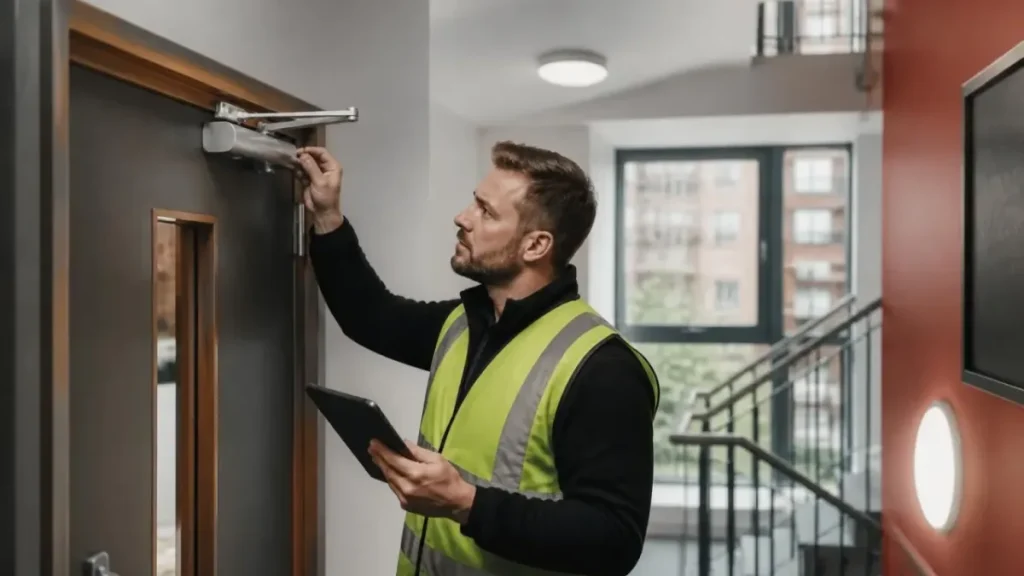
Fire Door Self-Closers

Testing overhead hydraulic closers to confirm communal fire doors close firmly into door rebates from any open angle.

Smoke Ventilation (AOV)

Testing Automatic Opening Vents (AOVs) at the top of stairwells to ensure smoke exhausts clear escape routes during an evacuation.

Signage & Fire Action Notices

Checking clear, legible Fire Action Notices detailing the building’s “Stay Put” or “Simultaneous Evacuation” strategy.

Service Penetration Seals

Inspecting intumescent mastic and fire pillows sealing electrical cables passing between floor compartmentation levels.

Why choose Smart Property Checks?

Smart Property Checks works with accredited Institute of Fire Engineers (IFE) registered assessors specializing in residential block compliance. For freeholders, RMCs, and block managers in the capital, book our comprehensive fire risk assessment in London covering communal hallways, staircases, and fire doors. We provide clear, itemized risk matrices accepted by London borough councils and insurers. Contact our team to schedule your survey.

The booking process

  1. Select your communal area fire assessment based on building storeys and unit count
  2. We arrange seamless access with your building manager or keyholder
  3. Our accredited fire assessor conducts a comprehensive on-site survey
  4. Receive your complete digital Fire Risk Assessment document in 24 to 48 hours

Book your communal area fire risk assessment today with Smart Property Checks and keep your residents safe.

Common Questions

The building freeholder, managing agent, Residents Management Company (RMC), or landlord is designated the “Responsible Person” under UK fire safety law.

Yes. Under the Fire Safety Act 2021, flat entrance doors are legally part of the communal assessment and must meet 30-minute fire resistance (FD30S) standards.

A Stay Put policy advises residents not directly affected by fire in their flat to remain inside, relying on high-performance compartmentation walls to contain fire spread.

Assessments should be reviewed annually for HMOs and converted buildings, and at least every 2 to 3 years for modern purpose-built blocks of flats.

A communal area assessment for a standard residential block typically starts from £149 to £350 depending on number of storeys and communal complexity.

No. Fire safety regulations enforce a strict “sterile corridor” policy prohibiting doormats, bicycles, prams, and rubbish bags in escape routes.

Yes. Emergency lighting in common stairwells must undergo monthly functional flick tests and annual 3-hour battery discharge tests.

Yes. We provide fire risk assessments for mixed-use residential-commercial developments, offices, and retail blocks.

Book your communal fire risk assessment with Smart Property Checks

Ensure your residential block meets all UK fire safety regulations and avoids enforcement action. Book your assessment with certified IFE assessors in minutes.

Scroll to Top
0