
Commercial EPC Rules for Landlords: 2026 MEES & Exemption Guide
Under the Energy Efficiency (Private Rented Property) (England and Wales) Regulations 2015, commercial property owners face stringent energy standards. Understanding the latest commercial epc rules for landlords is essential to avoid unlawful leases, property devaluation, and massive financial penalties. You can book an accredited Commercial Energy Performance Certificate (EPC) with certified Non-Domestic Energy Assessors.
For official government regulations on non-domestic energy standards, review the GOV.UK Non-Domestic MEES Guidance.
What are the current MEES minimum EPC requirements for commercial property?
Since April 2023, it is unlawful for commercial landlords to grant a new tenancy or continue letting an existing commercial property with an EPC rating below Band E, unless a valid exemption has been registered on the PRS Exemptions Register.
UK government policy targets higher energy thresholds, aiming for a minimum commercial EPC Band C by 2027 and Band B by 2030 across all non-domestic buildings.
Commercial EPC exemptions and the 7-year payback rule
Landlords of sub-standard commercial properties (Bands F and G) may register a statutory exemption lasting 5 years under specific legal grounds:
- 7-Year Payback Test: Energy improvements are not required if the expected energy savings over 7 years do not exceed the purchase and installation costs.
- All Relevant Improvements Made: When all cost-effective energy measures have been installed but the building still fails to achieve Band E.
- Third-Party Consent Refusal: If tenants, superior landlords, planning authorities, or mortgagees refuse necessary consents for energy retrofits.
- Devaluation Exemption: If an independent RICS surveyor confirms energy modifications would reduce property market value by more than 5%.
- Temporary Exemption: A 6-month grace period granted to new commercial landlords who recently acquired tenanted property.
- 10-Year Certificate Validity: A Non-Domestic Commercial EPC remains valid for 10 years unless major HVAC or layout alterations occur.
- Lease Validity: Letting a sub-standard commercial building does not invalidate the lease, but the landlord remains liable for heavy council fines.
- Who Pays for EPC: The building owner or prospective landlord is legally responsible for procuring and paying for the Commercial EPC.
- Listed Buildings: Historic buildings are only exempt if compliance would unacceptably alter their architectural character.
Local Weights and Measures Authorities enforce commercial MEES compliance. Fines for letting a non-compliant commercial property for under three months reach 10% of rateable value (minimum £5,000, maximum £50,000). For breaches over three months, penalties rise to 20% of rateable value (minimum £10,000, maximum £150,000) plus public publication on the enforcement register.
How to improve a commercial building EPC rating cost-effectively
Upgrading to high-efficiency LED lighting with PIR occupancy sensors, installing smart building energy management systems (BEMS), modernizing heat pumps, and sealing thermal envelope air leakages provide the fastest, highest-impact improvements to non-domestic energy scores.
Book Your Property Safety Certificate Online


Domestic Electrical Safety Certificate EICR 6 Bedrooms

Fire Risk Assessments For All Business Sectors

Domestic Electrical Safety Certificate EICR 1-3 Bedroom
Key building systems audited during a commercial EPC survey
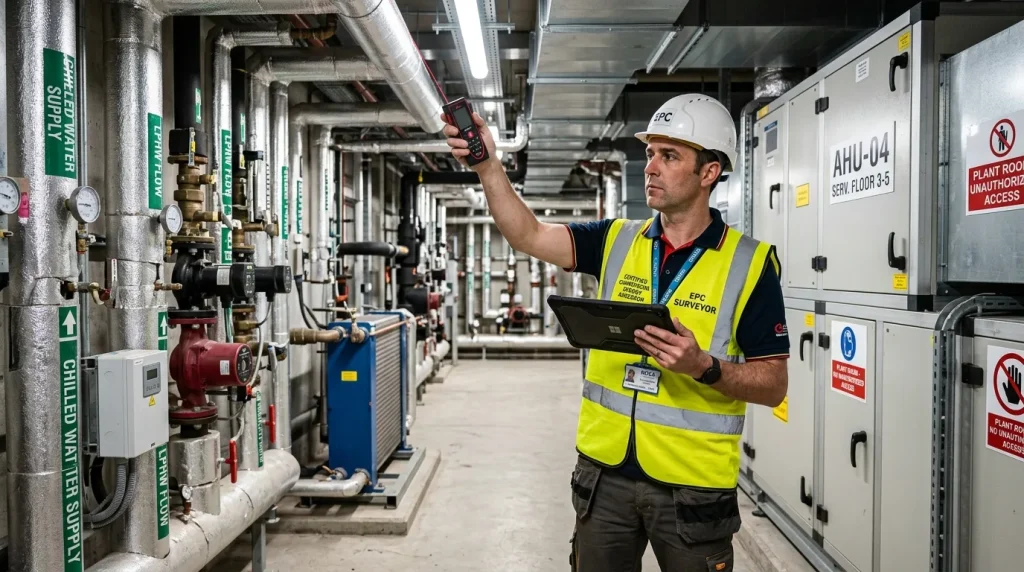
HVAC & Mechanical Plant
Evaluating central boiler efficiencies, chiller coefficient of performance (COP), heat recovery units, and ventilation ductwork.
Lighting & Control Systems
Calculating lighting efficacy (lumens per circuit-watt), daylight dimming controls, and localized zone switching.
Building Thermal Envelope
Measuring U-values of external cavity walls, curtain wall glazing, insulated cladding panels, and flat roof constructions.
Renewable Energy Installations
Assessing rooftop photovoltaic (PV) solar arrays, commercial heat pumps, and solar thermal hot water systems.
Why choose Smart Property Checks?
Smart Property Checks works with Level 3, 4, and 5 accredited Non-Domestic Energy Assessors (NDEA) across the UK. We provide accurate SBEM energy modeling, tailored EPC improvement roadmaps, and rapid digital certificates. Contact our team to schedule your survey.
The booking process
- Submit your commercial building floor area, property type, and location online
- Our accredited Non-Domestic Energy Assessor conducts a comprehensive site survey
- We model building data using approved Simplified Building Energy Model (SBEM) software
- Receive your official Commercial EPC Certificate and Recommendation Report in 48 hours
Book your commercial EPC assessment today with Smart Property Checks and ensure complete MEES compliance.
Common Questions
What is the minimum legal EPC rating for a commercial property?
Under current MEES regulations, commercial rented properties must achieve a minimum EPC rating of Band E unless a valid statutory exemption is registered.
What are the penalties for commercial MEES non-compliance?
Fines range from 10% to 20% of the property’s rateable value, up to a maximum penalty of £150,000 per violation, plus publication on the public breach register.
Who is responsible for paying for a commercial EPC?
The commercial landlord or building owner is legally responsible for obtaining and paying for the Commercial EPC before marketing or leasing the property.
How long does a commercial EPC certificate last?
A Commercial EPC is valid for 10 years from the date of issue, unless significant modifications are made to the building’s thermal envelope or heating systems.
How long does a commercial MEES exemption last?
Most registered commercial MEES exemptions (such as the 7-year payback test or third-party consent refusal) are valid for 5 years.
Do listed commercial buildings need an EPC?
Listed buildings require an EPC unless the owner can demonstrate that implementing minimum energy improvements would unacceptably alter the building’s historic character.
What are the proposed future commercial EPC targets?
The UK government has proposed tightening commercial MEES standards to a minimum of Band C by 2027 and Band B by 2030.
How much does a commercial EPC cost in the UK?
Commercial EPC costs vary based on floor area and building complexity (Level 3, 4, or 5), typically starting from £150 to £450 for standard commercial premises.
Book your commercial EPC survey with Smart Property Checks
Protect your commercial leases and prevent massive council fines. Book your non-domestic energy assessment with accredited assessors and receive certified reports in 48 hours.
Related Blogs
EPC Rating Rules for Landlords 2026: Band E Minimum Standards & MEES Guide
Home Editorial Note: Written by the Smart Property Checks Energy…
Commercial EPC Rules for Landlords: 2026 MEES & Exemption Guide
Home Under the Energy Efficiency (Private Rented Property) (England and…
EPC Certificate Guide: What UK Landlords and Homeowners Need to Know
Home An EPC certificate - or Energy Performance Certificate -…